
Cactus Criminal History Checks
A Cactus search works best when the requester first separates city, custody, court, and state records. Cactus Police Department owns the reports its officers make. Cactus Municipal Court owns city ordinance, traffic, and qualifying Class C files. Moore County Sheriff owns the jail booking after physical intake. The County Clerk or District Clerk owns a higher criminal case after prosecutors file it. Official Census data supports the population ranking, but DPS maintains the state repository cycle.
Use a narrow sequence so each office receives a request it can answer:
- Identify whether Cactus PD, another agency, or a court created the record.
- Request the exact Cactus police report, dispatch entry, crash record, or video from the city.
- Ask Cactus Municipal Court about a citation, fine-only docket, or city warrant.
- Call Moore County Sheriff for booking, bond, release, or transfer status.
- Check the proper county clerk and DPS only when the matter reached those levels.
A name alone may be too broad for city staff. Add a report, citation, or case number, plus an approximate date and the relevant agency. That makes a Cactus record check more precise and reduces false matches.
Cactus Police Requests Without a Form
No official online report-copy form was found for Cactus. That does not block Cactus access. Send a focused Texas Public Information Act request to Cactus and ask that it be routed to the Cactus police custodian. State the existing Cactus item wanted, such as an incident report, arrest report, CAD entry, body-camera recording, or crash record. Include the incident number when known, a date and time range, location, involved party, preferred delivery, and a cost limit.
The official Cactus Police page is the source for the department’s current public information.
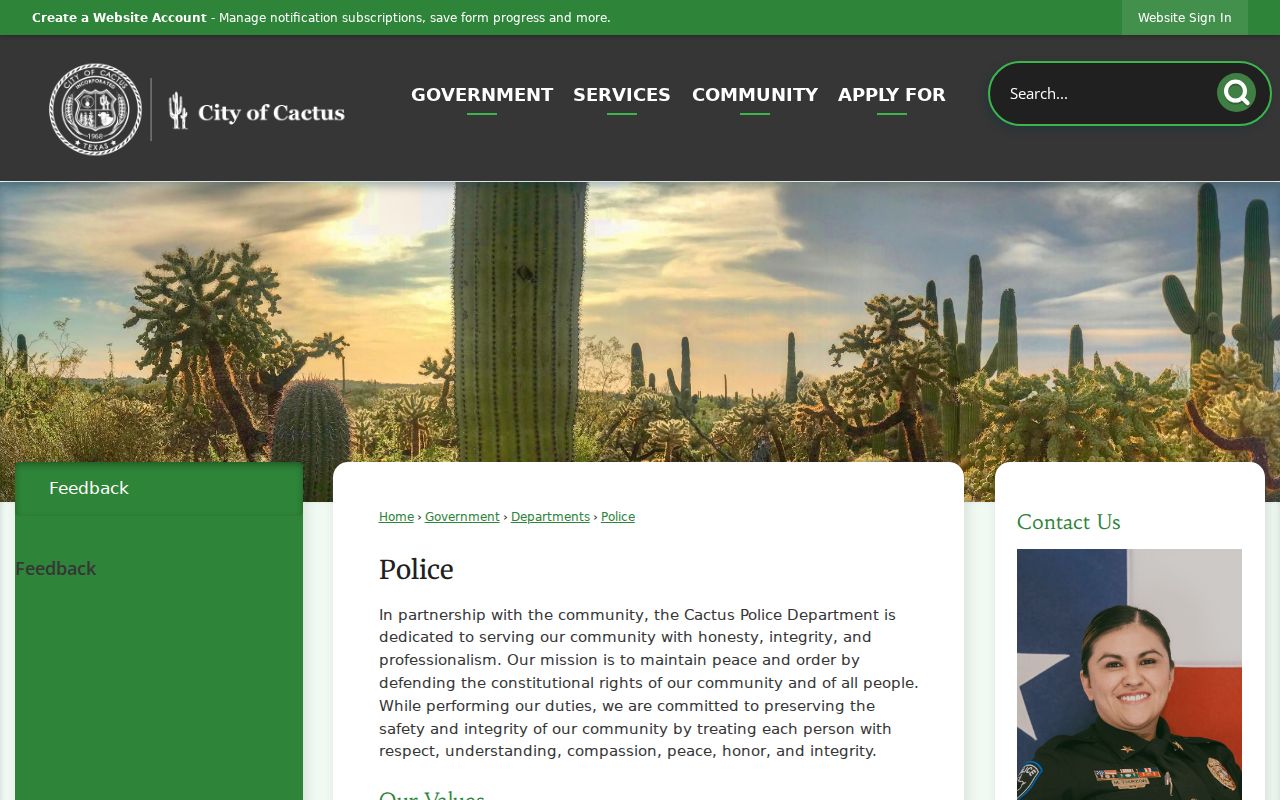
The captured page identifies the Cactus police channel that owns Cactus reports, which is distinct from the Moore County court and jail offices.
Protected fields may be redacted. Active-case details, juvenile information, certain victim identities, medical data, driver’s-license numbers, and records subject to expunction or nondisclosure do not become public merely because a request was filed.
Records at the Cactus Police Department
Cactus PD creates the first Cactus record for events handled by its officers. A Cactus offense report records the allegation and investigation. A Cactus arrest report records the grounds, time, place, officer, and arrest charge. A crash report and body-camera file are separate items. Requesters should name each desired Cactus record because asking for one does not automatically produce the others.
The department’s official page says Cactus provides police services under professional best practices adopted through the Texas Police Chiefs Association Best Practices Program. That statement speaks to departmental practice, not the public status of every record. Release decisions still follow Texas law and the facts of the case. No official Cactus arrest blotter, warrant search, police mobile app, or dedicated records portal was located.
For Cactus video, provide the date, approximate time, exact location, and a known subject. For Cactus paper or electronic reports, ask whether Cactus can inspect the record, email a copy, or certify it. No local fee schedule was documented, so obtain an itemized estimate from Cactus before authorizing copies.
Cactus Best-Practices Program Context
The best-practices statement on the city police page is useful local context, but it is not a search tool or a promise of instant disclosure. It tells a requester where departmental responsibility begins. It does not transfer Cactus police records to a county clerk, and it does not turn the police page into a complete log of incidents or arrests.
Treat the program statement as a Cactus agency identifier. Send Cactus enough details to locate the record, and expect the custodian to review the requested material for statutory exceptions. If no report number is known, narrow the date, time, and location. Ask for a written explanation of any withholding or redaction. Under the Public Information Act, Cactus releases existing public information or invokes a lawful exception; it does not have to create a report or conduct open-ended research.
Note: Cactus city records remain separate even when a related booking or prosecution later appears in Moore County.
Booking and Arrest Records in Cactus
A person arrested by Cactus PD is ordinarily routed into the Moore County jail system rather than a city-run long-term jail database. Cactus retains the arresting officer’s report. Moore County Sheriff creates the booking sheet and jail-register entry at 700 South Bliss Avenue in Dumas. These records capture different parts of the same event.
No Cactus or Moore County official online arrest blotter was found. Call the Sheriff’s Office at 806-935-4145 for present custody, booking number, listed charges, bond, and release or transfer status. VINELink is an additional custody-notification route linked from the sheriff’s official page, but it does not replace direct confirmation. For an older Cactus booking, request the booking sheet, jail register, or release record under the Public Information Act.
Booking is not a conviction. The district attorney can decline, reduce, or change an arrest charge. A clerk’s final judgment carries more weight for the outcome than an intake label. If state-prison custody later follows a conviction, switch from the county sheriff to the official TDCJ inmate search.
Cactus Citations Versus County Cases
The level of the filed offense controls the court. A Cactus traffic or ordinance citation and other qualifying fine-only Class C matters stay with Cactus Municipal Court. Class A and B misdemeanors go to Moore County Court at Law. Felonies go to the 69th Judicial District Court. A county clerk name search can therefore miss a Cactus citation even when the municipal file exists.
| Record | Custodian | Best identifier |
|---|---|---|
| Cactus citation | Cactus Municipal Court | Citation or case number and violation date |
| Jail-punishable misdemeanor | Moore County Clerk | Case number, name, and filing year |
| Felony | Moore District Clerk | Case number, name, and filing year |
The county clerks are not a substitute for the Cactus clerk. Likewise, the Cactus court cannot produce a county judgment. Confirm the Cactus court named on a citation, bond paper, or charging document before requesting copies.
The Cactus Municipal Court File
The official Cactus Municipal Court page is the starting point for city-level case contact.

The Cactus court interface supports direct contact with the Cactus custodian when no public online docket is available.
| Court Name | Cactus Municipal Court |
|---|---|
| Case Types Heard | City ordinance, traffic, and eligible fine-only state-law matters. |
| Case Lookup Channel | Official court or staff page, then telephone or counter; no search portal confirmed. |
| Useful Search Fields | Citation or case number, name and date of birth, violation date, and issuing officer. |
| Copies and Fees | Ask the municipal clerk; a Cactus schedule was not found in official research. |
A Cactus municipal warrant stays tied to the issuing court. Call the clerk before appearing to resolve one’s own warrant. Ask whether an appearance is required, how bond or payment is handled, and how clearance reaches law enforcement. Keep the receipt or order and confirm both systems updated.
Cactus Record Requests at City Hall
Cactus municipal functions are commonly listed at 201 South Highway 287, Cactus, Texas 79013, but a requester should verify the exact records counter and hours through the official staff directory before visiting. The Cactus city homepage provides the municipal starting point.

The city homepage is useful for routing a Cactus police or municipal request to city staff rather than an unrelated county office.
A clear Cactus written request needs no magic phrase. Identify the existing record, include locators, and say whether inspection or copies are wanted. Do not send more personal information than Cactus needs. If the request covers body-camera footage, add the statutory date, approximate time, location, and known subject details. If Cactus quotes a large cost, ask for an itemized estimate or narrow the scope.
For a crash, first identify the investigating agency. A Cactus location does not by itself prove Cactus PD made the report. A Texas DPS trooper’s crash record may be obtained through TxDOT CRIS instead.
How Cactus Records Reach the County
Cactus PD creates the arrest record. Moore County Sheriff creates the booking record. A magistrate handles the initial warning, probable-cause, counsel, and bond issues. The district attorney then reviews the submission, and the proper county clerk records any filed Class A or B misdemeanor or felony. Qualifying fingerprint and disposition data are reported to DPS.
Record flow: Cactus Police Department › Moore County Courts › Texas Department of Public Safety
DPS’s January 2026 compliance report lists one displayed Cactus PD cohort with 40 arrest actions, 40 prosecutor actions, and 35 court actions for 2024 arrest cycles. These are reporting-completeness counts, not total Cactus crimes or convictions. The difference shows why a state repository result can lag behind a complete local court file.
A Cactus arrest can also remain in police and jail records even when no county case is filed. Check the city report for the allegation, the sheriff for custody, and the signed court disposition for the result.
Cactus Fingerprints and DPS Results
At county intake, fingerprints support a tracking control number that links the arrest cycle to later prosecutor and court reporting. DPS uses those submissions to maintain the Computerized Criminal History system. The public DPS Criminal History Search exposes a legally public conviction and deferred-adjudication subset. It is not a complete fingerprint rap sheet.
A public name search costs one $3 credit plus the posted card-processing charge. Similar names can cause ambiguity, so treat a hit as a lead. A person reviewing their own identity-linked record should follow the DPS Review of Personal Criminal History process and schedule fingerprint capture through FAST and IdentoGO. A permanent Cactus enrollment site was not verified, so check the live locator before travel.
If the state cycle lacks a Cactus case outcome, obtain the certified dismissal, judgment, or sentence from the court that handled the prosecution. Then use the DPS challenge or correction process. A screenshot from a name search is weaker than an official source document.
Cactus Records When No Result Appears
No result in one database does not prove that no Cactus record exists. A municipal citation may never appear in a county felony search. A recent booking may not yet have a filed case. re:SearchTX coverage depends on clerk integration and access rules. The DPS public product omits information outside its statutory public subset.
Work backward from the event. Ask Cactus PD for its report, Cactus Municipal Court for a fine-only city case, Moore County Sheriff for custody, and the proper county clerk for the prosecution. If the file is older, ask whether it is paper, imaged, archived, or transferred. Supply an approximate year and court so staff can distinguish a record request from research.
- Arrest
- Police action based on alleged grounds, not a finding of guilt.
- Booking
- County jail intake following custody.
- Information
- A prosecutor-filed charging instrument often used for Class A or B misdemeanors.
- Disposition
- The court outcome for a charge.
Cactus Record Access Rules
Cactus must apply the Texas Public Information Act to city-held records. The law grants access to public information and allows exceptions for qualifying law-enforcement material. Redactions can protect juvenile data, victim information, medical details, driver’s-license numbers, and other confidential fields. Expunction and nondisclosure orders impose separate limits.
Key Statutes:
Texas Government Code Chapter 552 governs requests, response duties, and public-information exceptions.
Texas Government Code Section 411.135 authorizes the public DPS conviction and deferred-adjudication information.
Texas Code of Criminal Procedure Chapter 55A controls expunction and the treatment of covered records.
Send a Cactus request to the office that created the record. The city police custodian cannot certify a county judgment, and the County Clerk cannot supply a Cactus police narrative. Correct routing is the core of reliable access.