
Criminal Court Cases in Moore County
Moore County criminal court cases are divided by charge level. Felonies go to the 69th Judicial District Court, and District Clerk Mayra Rivero keeps those files. The Moore County Court at Law hears Class A and Class B misdemeanors, with the County Clerk serving as file custodian. Fine-only state cases may remain in a justice court. Dumas, Cactus, and Sunray municipal courts keep their own city ordinance and fine-only dockets.
This split affects every search. A Dumas citation will not turn up at the District Clerk merely because Dumas is the Moore County seat. Likewise, the Sheriff’s booking entry is not the criminal case file. Start by identifying whether the event became a felony, a county-level misdemeanor, or a lower-court matter. Then ask that court for the case number, status, charging instrument, docket sheet, final judgment, and any certification price.
Two Moore County Court Clerks
The felony and misdemeanor counters sit in the same courthouse, yet they have different authority. The Moore County District Clerk works from Room 109 at 715 South Dumas Avenue. Its published hours are Monday through Thursday, 8:30 a.m. to 5 p.m., and Friday, 8:30 a.m. to noon. The office number is 806-935-4218.
Across the building, the Moore County Clerk works from Room 107 and may be reached at 806-935-2009 or 806-935-6164. That office keeps County Court at Law misdemeanor files. Its posted warning says staff do not perform open-ended research not authorized by law, so a broad name request may fail. Supply the case number when possible, plus the defendant’s full name, approximate year, court, and offense level.
District Clerk
715 S. Dumas Ave., Room 109
Dumas, TX 79029
806-935-4218
Mon–Thu 8:30–5; Fri 8:30–noon
County Clerk
715 S. Dumas Ave., Room 107
Dumas, TX 79029
806-935-2009
County Court at Law files
The manifest image comes from the official District Clerk page.
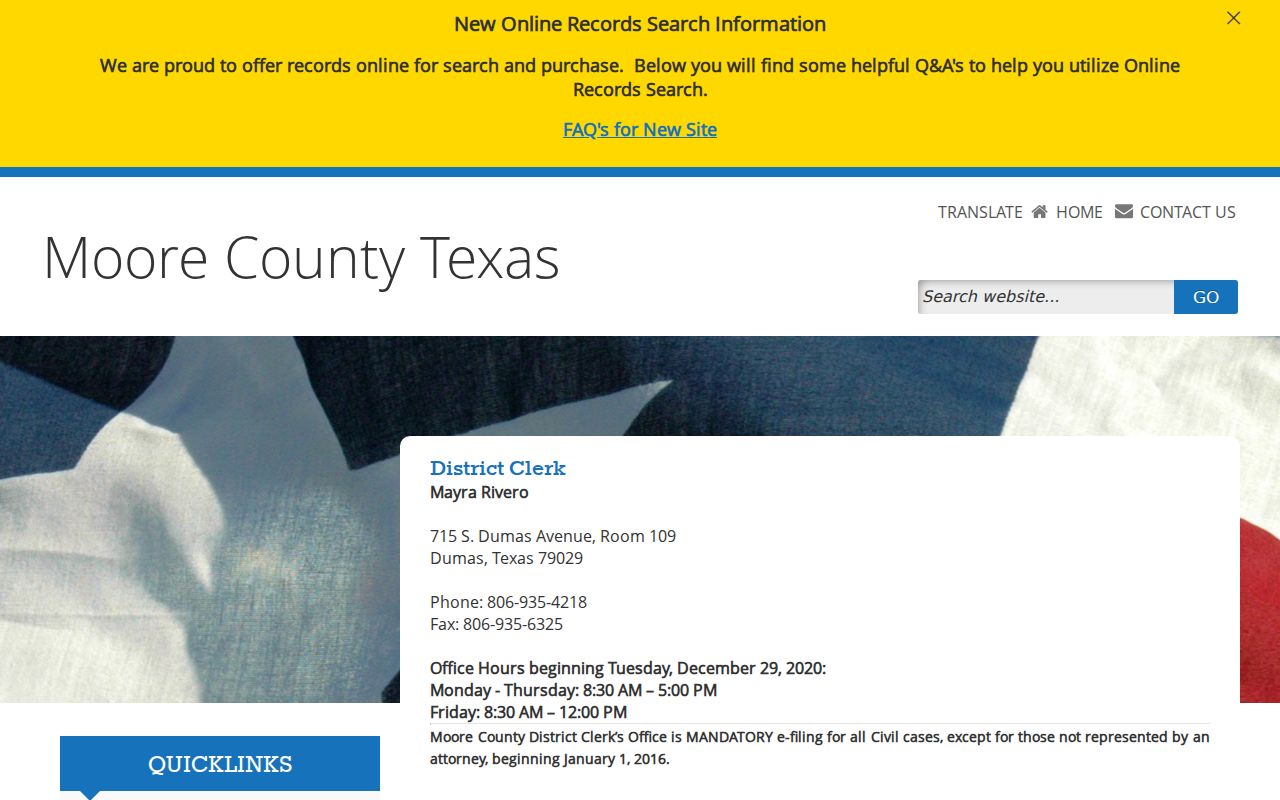
It shows the Moore County source for felony contacts, office hours, court resources, and the locally posted expunction link.
Note: District Clerk hours end at noon Friday, so confirm access before planning a Moore County felony-file visit.
Moore County Case Record Searches
No confirmed Moore County criminal case portal supplies a complete Moore County docket. The best method pairs re:SearchTX with direct clerk verification. Registration is required, and the official re:SearchTX quick reference explains the search categories, filters, saved searches, and exports. Local coverage, older-file conversion, document images, and access rights still depend on each clerk’s integration.
- Choose the likely court from the charge level: District Court for a felony, County Court at Law for a Class A or B misdemeanor, or the issuing municipal or justice court for a fine-only case.
- Register or sign in to re:SearchTX, then search Cases, Filings, Text in Documents, or Hearings with the strongest known identifier.
- Use the left-side filters to narrow by court, filing period, case type, or other displayed values. Open the case description to inspect Case Details.
- Call the correct Moore County clerk with the name, case number, filing year, and requested document. For upcoming County Court at Law dockets, call Moore County’s published coordinator line at 806-935-2440.
- Request the docket, charging instrument, judgment, sentence, dismissal, or certified copy from the clerk. Ask whether an older file is paper, imaged, archived, or transferred.
| Control | Type | Required | Use |
|---|---|---|---|
| Sign in/Register | Account | Yes for full service | Uses eFileTexas credentials |
| Search | Keyword text | No | Submit with Enter or search icon |
| Category tabs | Tabs | Yes | Cases, Filings, Text in Documents, Hearings |
| Advanced Search | Panel | Optional | Filters vary by data type |
| Left-side filters | Filters | Optional | Narrow displayed results |
| Case description | Result link | No | Opens Case Details |
| Export / Save | Buttons | Optional | Exports results or stores a query |
Saving or exporting an online result preserves the lead, but it does not replace a clerk-certified judgment or dismissal from the Moore County court file.
Verify Moore County Online Leads
re:SearchTX is a lead, not a certified Moore County case search. The statewide interface can display case headers, party names, filing dates, status, events, hearings, and filing descriptions when the local court supplies them. Document images may be limited or may carry a fee. Historical conversion also varies. A clerk’s paper or imaged file can therefore be more complete than the web view.
When the docket shows an outcome but not the signed order, ask for the judgment or dismissal itself. That document gives far stronger proof than a search-result screen. A final local order may also exist before the linked DPS criminal-history cycle is updated. For a broad review of court activity, the online tool saves time. For a specific outcome, certification, or no-record question, the relevant Moore County clerk remains the source.
Note: A missing web result is not proof that Moore County has no criminal case under that name.
Federal Cases Outside Moore County
Federal criminal cases do not appear in the Moore County clerks’ files. Moore County lies in the Northern District of Texas, and federal dockets use PACER. That system requires registration and applies the federal judiciary’s current access-fee policy.
The manifest image comes from the official PACER service.
PACER searches federal court records, not cases filed in Moore County District Court, County Court at Law, or a local municipal court.
What a Criminal Case File Contains
A Moore County criminal case file records the court process after a charge is filed. It differs from the arresting agency’s incident report and the jail’s booking record. The most useful papers often are the charging instrument, docket sheet, and signed outcome. Together they show what prosecutors filed, what occurred in court, and how each charge ended.
| Case Number & Court | Identifies the file and whether it belongs to District Court, County Court at Law, or a lower court. |
|---|---|
| Charging Document | An indictment commonly charges a felony; an information commonly charges a Class A or B misdemeanor. |
| Docket Entries | Chronological filings, settings, motions, appearances, and orders entered in the Moore County case. |
| Hearing Dates | Past or scheduled events, sometimes with hearing type, time, and location. |
| Disposition & Judgment | The charge outcome, such as conviction, dismissal, acquittal, deferred adjudication, or no-bill where applicable. |
| Sentence & Conditions | Custody, fine, restitution, or community-supervision terms imposed after the relevant outcome. |
Full birth dates, Social Security numbers, protected victim details, grand-jury deliberations, juvenile data, and sealed or expunged material should not be expected in a public view. Financial ledgers may also be absent from an online result.
Note: Request the signed outcome document when the docket label alone does not make a Moore County case disposition clear.
Read Moore County Case Outcomes
Outcome terms must be read with care. “Dismissed” means that charge ended without a conviction, but it does not by itself erase the arrest or booking record. “No-bill” means the grand jury declined to return a felony indictment. “Acquitted” records a not-guilty outcome. A conviction should be confirmed through the signed judgment rather than inferred from bond, jail time, or a hearing entry.
- Deferred adjudication
- The court defers a finding of guilt while the person completes community supervision. It does not automatically erase the public record.
- Docket
- The running list of court filings, settings, and events, not the full text of every paper.
- Information
- A prosecutor-filed charging paper commonly used for Class A and B misdemeanors.
- Indictment
- A felony charging instrument returned by a grand jury.
- Disposition
- The recorded result of a charge, such as dismissal, acquittal, conviction, or deferred adjudication.
A person reviewing their own Moore County file should obtain the final order before seeking a correction or considering expunction or nondisclosure. The District Clerk links official expunction information, but eligibility depends on the full arrest episode and current Texas law.
Criminal Case Stages in Moore County
A custodial arrest begins with prompt magistration. The magistrate gives warnings, reviews probable cause, addresses counsel, and considers bond. Texas law calls for this without needless delay and generally within 48 hours. The 69th Judicial District Attorney then reviews law-enforcement submissions. A felony may proceed through grand-jury indictment, while a Class A or B misdemeanor ordinarily proceeds by information.
Case flow: Charges Filed → Arraignment → Pretrial → Plea or Trial → Disposition → Sentencing
Discovery, motions, plea talks, trial, judgment, and sentencing create separate docket entries and papers. An appeal or motion for new trial can add later events. Bond and appointed-counsel records may arise before an indictment, so an early file can look thin. The clerk can explain what has been filed, but cannot give legal advice or predict the next ruling.
Moore County Case Reporting to DPS
After a Moore County case ends, the clerk and prosecutor report disposition data so DPS can pair the court result with the fingerprint-supported arrest cycle. That multi-agency handoff can lag or remain unmatched even when the courthouse file is complete. The January 2026 DPS compliance publication includes rows for Cactus Police, Dumas Police, the Moore County Sheriff, and Sunray Police.
The displayed 2024 cohort totals 115 arrest actions, 111 prosecutor actions, and 102 court actions; a second cohort shows 142, 114, and 66. These are reporting-completeness measures, not crime, arrest-rate, or conviction totals. Their value is narrower: they show why a state repository entry and a local final judgment may not line up at the same moment. When the two conflict, obtain the signed Moore County order and ask the relevant clerk about disposition reporting.
Note: DPS completeness rows measure agency reporting links, not the number of crimes, arrests, prosecutions, or convictions in Moore County.
Call for Moore County Dockets
Moore County itself directs readers to call 806-935-2440 about upcoming County Court at Law dockets. That instruction matters because Moore County publishes no searchable local criminal docket. Use the phone channel when re:SearchTX shows no setting, then confirm the case number, court, and date with the coordinator or County Clerk.
For felony status, contact the District Clerk instead. A Friday-afternoon visit is risky because its posted Friday hours end at noon. Before traveling, ask whether the requested file is available for inspection, whether copies may be sent electronically, and what plain or certified copies cost. No official local criminal-copy fee schedule was found in the research.
The official County Clerk image documents the misdemeanor contact route and the office’s no-search warning.

That warning is why a narrow, document-focused request works better than asking staff to research every person with a common name.
Access Rules for Case Records
Public access depends on the record and its custodian. The Texas Public Information Act governs many government records, while court case files are obtained from the clerk under the laws and court rules that apply to those files. Texas Rule of Judicial Administration 12 governs judicial records but distinguishes them from court case records.
The Texas Government Code Chapter 411 controls public criminal-history dissemination and nondisclosure. Code of Criminal Procedure Chapter 55A governs expunction, while the district-clerk retention schedule explains how long court records are kept. Confirm the result through the Moore County clerk and use a certified final order when accuracy is critical.